My little observation about cultures in East Asia covering some aspects from music, dance, belief, language to Japanese pop songs. I am doing some researches by citing books and information from trusted websites and journals, not blogs or Wikipedia.
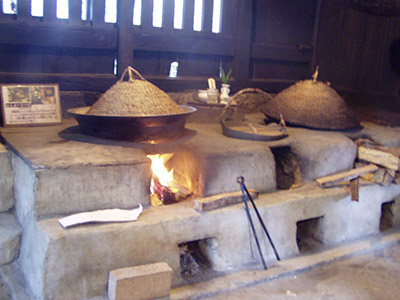
Typical of stoves in Okinawan traditional home with offering for household deity. Source: mugisha.net.
In the Ryukyuan indigenous religion, women are appointed as religious leaders who carry out various rituals for the community. Daily rituals at home are performed in the kitchen fireplace where prayers for ancestors are performed by the oldest woman in the house. Monthly ceremonies for ancestors and agricultural ceremonies are mostly performed by her sister. The first god who received the offerings is the kitchen god (fii nu kan 火の神 / ヒヌカン).
The role as ceremony leader is carried out until she dies and is then carried on by his daughter-in-law or the eldest woman in the house. The kitchen god is the most important household god whose job is to protect its inhabitants. This kitchen god must be reported about things that happen in the house such as births, marriages, moving, and deaths. The kitchen god is even still revered in modern homes on a shelf on the north wall of the kitchen in the form of a censer, a small vase with a branch of susuki, an offering bowl filled with salt, rice and sake.
The gods can also be symbolized by three conical stones from the shore. On Izena Island, these stones will be replaced with new ones when the head of the household dies. Meanwhile, in another area, an earthen kitchen fireplace was demolished and rebuilt after the death of the eldest female in the house.
References:
1. Holy Women in the Twentieth Century on JSTOR(Onarigami: Holy Women in the Twentieth Century, Monika Wacker. Japanese Journal of Religious Studies, Vol. 30, No. 3/4, Feminism and Religion in Contemporary Japan (Fall, 2003), pp. 339-359. Nanzan University.
"Tomb
in Lew Chew", M.C. Perry, Narrative of the expedition of an American
squadron to the China Seas and Japan (Wikimedia Commons)
Sueyoshi Park, Naha, modern Okinawa. Photo by 663highland (Wikimedia Commons).
According to "The Loochoo Islands" by Charles S. Leavenworth,
Ryukyuans were deeply influenced by the concept of filial piety that's
why ancestor worship is an important part of Ryukyuan culture.
"As
to religion, the Loochooans may be said to be a people almost devoid of
religious sentiments. There are Buddhist priests on the islands but
these, we were told, only officiated at ceremonial occasions like
funerals and had no influence as religious or ethical leaders. There are
no Buddhist monasteries there. The work of the Catholic fathers at
Oshima and of Bishop Evington and Mr. Schwartz has already been referred
to. There are three places of Protestant worship in Okinawa but no
church. The Loochooans, however, in common with the Chinese, think a
great deal of their ancestors. They have tablets to their memory in
their houses and spend much money on the graves, which are constructed
as solidly as well-built houses. In fact, when a traveller approaches
Naha from the sea, the graves shine on the surrounding slopes like
clusters of white stone dwellings."
References:
1. The Loochoo Islands, Charles S. Leavenworth. Professor of History, Imperial Nanyang College, Shanghai, 1905. p.38
Here is one of the most beautiful Okinawan tunes and dance. I've posted this article on Uchinanchu Kenjinkai group in Facebook around January 2021 and made some addition according my writing in Indonesian language Wikipedia.
Hamachiduri (浜 千 鳥), Hamachiduribushi (浜 千 鳥 節), also known as Chijuyaa (チ ジ ュ ヤ ー) is an Okinawan folk song title meaning "song of plover", tells of longing for one’s homeland.
Although
the composer is unknown, the song is believed to have been composed by a
traveler, possibly a merchant who sailed on a ship brought to the far
shore by the Black Current (Kuroshio). The repetition after the main
lyrics focuses on an imitation of the plover’s tweet “chui chui”.
The
dance that is danced to the accompaniment of songs also contains the
first meaning of the traveler (sailor) 's a deep longing for his home,
the second also means the longing for the lost Ryukyu Kingdom. The
hamachiduri dance is a "zoo-odori" ("mixed dance") genre. It was born in the entertainment theater (shibaigoya /
芝 居 小屋) in the Naha area, circa the 1890s. The Hamachiduri dance is
usually performed by two or more female dancers wearing dark blue
kasuri.
According
to another interpretation, this song's background is the Japanese
annexation of the Ryukyu in which the poor Okinawans were forced to
leave their homes to work hard. Some boys are sold to fishermen as
contract workers and young women who are sold into prostitution. This
song represents the feelings of a boy who was sold to a fisherman.
Hamachiduri Bushi lyrics
Okinawan Romanization by Taru(taru.ti-da.net)
the first line of the English translation is by Christopher T. Nelson.
the third line of the English translation is by Wesley Iwao Ueunten.
the rest of the translation is my own effort, if you find some errors please tell me. thanks
旅や浜宿い 草ぬ(ヤリ)葉ぬ枕 寝てぃん忘ららん 我親ぬ御側
tabiya hamayadui kusanu (yari)hwaa nu makura nitiN washiraraN wa’uyanu ‘usuba
travelling, I rest on the beach.
leaves of grass for my pillow
although I sleep, I cannot forget
the times with my mother and father
ref : 千鳥や 浜居てぃ チュイチュイナ
chizuyaa ya hama wuti chui chui naa
on the beach,
the plover cries "chui chui"
旅宿ぬ寝覚め 枕すばだてぃてぃ 覚出すさ昔 夜半ぬ辛さ
tabiyadu nu nizami makura subadatiti ‘ubizasusa ‘Nkasi yuhwa nu chirasa
awaken at the inn
I take my pillow
I remember the old days
in the middle such of a sad night
渡海や 隔じゃみてぃん 照る月やふぃとぅち あまん眺みゆら 今日ぬ空や
tukeya hwijamitiN tiru chichi ya hwituchi ‘amaN nagamiyura kiyu nu sura ya
1. https://books.google.co.id/books?id=msHWGYdXCNYC&pg=PA130&lpg=PA130&dq=hamachidori+dance&source=bl&ots=SEpCOqUYZK&sig=ACfU3U1AS_8dVX6U3bJ21OyhBvklX4kDgQ&hl=id&sa=X&ved=2ahUKEwjXxMyKtbDoAhX-H7cAHS8RApEQ6AEwCXoECAgQAQ#v=onepage&q=hamachidori%20dance&f=false (Dancing
with the Dead: Memory, Performance, and Everyday Life in Postwar
Okinawa. (2008). Christopher T. Nelson, Duke University Press. p130-131)
4. Nothing Can Compare: A Selection of
Okinawan Folk Songs. WESLEY IWAO UEUNTEN. Manoa, Vol. 23, No. 1, Living
Spirit: LITERATURE AND RESURGENCE IN OKINAWA (summer 2011), pp. 65-70.
University of Hawai'i Press.
Miruku Munari (ミルクムナリ)
is a title of eisa song that is popular in Japan as well as in Okinawan
communities in many countries. The name of this song means "The Dancing
Miruku", derived from a combination of the Okinawan words "Miruku" (Maitreya) and the Indonesian word "Menari" which means "Dancing".
The lyrics come from the Ryukyuan Language of Kohama Island, Yaeyama
Islands which originally was a prayer asking for an abundance of
agriculture and crops through the gods' blessings. So Miruku Munari can
also mean "The Dancing God".
The song's composition was done by a musician from Taketomi Island called Hidekatsu Kamei or better known as Hidekatsu (日出克).
Hidekatsu released the song as a single in 1993 and included it in his
1994 album, Shinpi Naru Yoake (神秘なる夜明け). The song was later popularly
used as an Eisa song.
Hidekatsu
explained that at first the song Miruku Munari included elements of the
Andean bamboo drum from South America, so he called it "world music".
The drum sound used in the original version was later mistaken by his
Okinawan friends as the typical Okinawan drum sound as in Eisa's
performances. This song was later used by Ryukoku Matsuri Daiko and became one of the most popular songs about Okinawa.
With the help of Daiichi Hirata (平田大一),
a friend from Kohama Island, Hidekatasu decided to incorporate elements
of Okinawan culture into the song in the form of the ritual verses of
Kohama Kuduchi which are usually sung at the Ketsugan-sai Festival,
Kohama.
This
song had become controversial because it was opposed by the people of
Kohama who considered sacred ritual poetry inappropriate to be heard by
the wider audience outside Kohama Island. This resulted in Hidekatsu
being unable to visit Kohama for several years.
Although
the lyrics of the verse were created by the inhabitants of Kohama
Island, various other islands and villages in Okinawa also have similar
Kuduchi verses. Kuduchi verses originally originate from the main island
of Japan. However, the use of these lyrics in the pop song Miruku
Munari led to strong opposition from the Kohama community, because the
island's social life was still more closed off than other areas of
Okinawa.
Lyrics verse: Kohama Kuduchi.
Yaeyaman Language romanization and English translation by Matt Gillan.
Kutushi Miriku nu, yugafu dushi sami (This year is a prosperous year)
Miriku ganashi nu, urui misōchi (Miruku has graced us with his presence)
Gukuku munu dani, utabimimisetasa (We have been given the seeds for our crops)
Yadu nu yadu kaji, chine nu chine kaji (Each house, each household)
Kaji mata sandōnicchai (Enough for everyone)
Kutushi ini nu muitachi (The rice this year)
Sunchā Manchā manman mansaku (Has grown into a rich harvest)
Nī dikiduti, (In accordance with our prayers)
Ari ga uhachi ya, kōten ganashi ni, (First we'll give it in offering to the gods.)
Kahei usagiti, usagiti yu nukui, (The remainder)
Kura ni chinchiki, asagi ni chinchiki chin, (we'll pile it up in the storehouse, pile it up in the barn)
Amasōti tu, washita wakamunu, (There's still some left? We young people)
Amazaki Karazaki taririduti,(We'll make lots of sake)
3. https://cooljapan-videos.com/en/articles/qf239sk8(The Eisa of Ryukyu Budan Shoryu Matsuri Daiko!)
4. https://www.okistyle.com/a2z/?p=2289(Hidekatsu on Okistyle)
5. https://www.jstor.org/stable/25501574(Treasures of the Island People: Tradition and Modernity in Yaeyaman Pop Music.
Matt Gillan. Asian Music, Vol. 39, No. 1, [Popular Music in Changing
Asia] (Winter - Spring, 2008), pp. 42-68. University of Texas Pres.)


![日出克 (Hidekatsu) - デンサー節 (densaabushi) [1994?] - YouTube](https://i.ytimg.com/vi/n4LQguhIRdw/hqdefault.jpg)

